
Genghis Khan Or Napoleon Bonaparte
Genghis Khan Vs Napoleon Bonaparte, Who was more powerful and Greatest hero of the time.
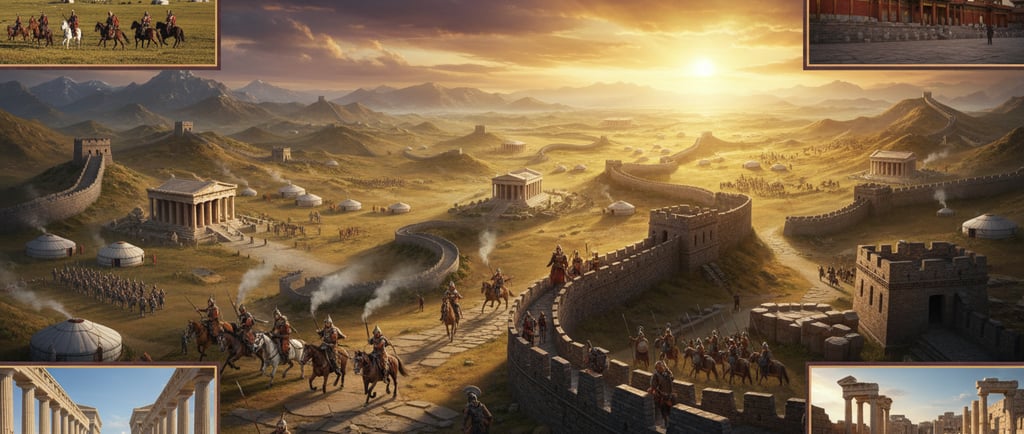
Founder from Nothing: Born as Temüjin, he rose from a destitute, orphaned outcast to unify the Mongol tribes and found the Mongol Empire, the largest contiguous land empire in history.
Military Reorganization: He revolutionized Mongol warfare by organizing his army into a decimal system (units of 10, 100, 1,000) based on merit and loyalty, breaking old tribal ties.
Master of Mobility and Terror: His strategy relied on extreme mobility from his horse archers, combined with calculated terror—massacring populations that resisted to compel others to surrender.
The Yassa Legal Code: He created a unified legal code, the Yassa, which established laws, protected trade, and administered justice across his culturally diverse empire.
Religious Tolerance: He was remarkably pragmatic and tolerant, granting freedom of religion across his empire and consulting with Christian, Muslim, Buddhist, and Taoist leaders.
Pioneer of Global Trade: His empire established the Pax Mongolica, which secured the Silk Road and enabled the first major era of unprecedented trade and cultural exchange between East and West.
Incorporation of Talent: He was a supreme meritocrat, who actively integrated skilled engineers, administrators, and soldiers from conquered peoples into his ranks.
Mysterious Burial: He died in 1227, and his burial site was kept a profound secret. To this day, the location of his tomb remains one of history's great mysteries.
Legacy of Khanates: His empire was divided among his sons and grandsons into smaller, powerful Khanates (like the Golden Horde and the Yuan Dynasty) that continued to dominate Eurasia.
Genetic Legacy: Studies suggest he may have a vast number of direct male-line descendants today due to the many children he and his close relatives had with consorts across the empire.
GENGHIS KHAN
NAPOLEON BONAPARTE
Self-Made Emperor: He rose from a minor Corsican noble family to become a military officer, then First Consul of France, and finally crowned himself Emperor in 1804.
Military Genius: He was a master of the envelopment strategy and the decisive battle of annihilation. His campaigns are still studied in military academies worldwide.
The Napoleonic Code: His most enduring legacy is the Napoleonic Code (Code Civil), a comprehensive legal system that replaced feudal laws and became the basis for many modern legal systems around the world.
Centralized Administration: He reformed the French state, creating a highly efficient, centralized bureaucracy, a national bank, and the lycée system of secondary education.
The Continental System: His failed economic warfare policy aimed to cripple Britain by blockading all European trade with the British Isles.
The Peninsular War: His decision to invade Spain and Portugal sparked a long, brutal guerrilla war that became a "bleeding ulcer" that drained his empire of men and resources.
The Disastrous Russian Campaign: His 1812 invasion of Russia was a catastrophic failure, where his Grande Armée of over 600,000 men was destroyed by the Russian winter and scorched-earth tactics.
Exile and The Hundred Days: He was first exiled to Elba in 1814, but escaped and returned to France, ruling for a final "Hundred Days" before his final defeat at Waterloo.
Final Exile to St. Helena: After Waterloo, he was exiled by the British to the remote island of Saint Helena in the South Atlantic, where he died in 1821.
The Art of Propaganda: He was a master of self-promotion, carefully controlling his public image through official paintings, bulletins, and the creation of the Legion of Honour to secure the loyalty of his soldiers and citizens.